


It’s the question that never goes away: should I call it a jew’s harp or a jaw harp? This has been an ongoing discussion not just for the past few decades, but the past several centuries. Debates about the origins of the instrument’s English name have existed for nearly as long as the instrument has been present in Western Europe, with urban legends and etymological theories—ranging from plausible to completely bonkers—persisting to this day. I wanted to clear up some of the history to show exactly what we do and don’t know about both terms, to help you make an informed decision about which to use. It’s also my hope that sharing this knowledge can help counter some of the misinformation that is so prevalent about this subject online.
Jew’s harp IS the oldest English name, period.
Known as ‘jew’s harp’ only in the English language, the instrument has no connection to traditional Jewish music or culture, and no established etymological explanation accounts for the name. ‘Jew’s harp’ IS the oldest recorded name in the English language. The name first appears in an English trade ledger in 1481 (a shipment of ‘jew's harps’ and ‘jew's trumps’ coming from The Netherlands to London), though archaeological finds and iconography show the instrument probably arriving in Britain earlier, in the 1200-1300s (see Kolltveit 2006 and Wright 2005 & 2015).
While jew’s harp is the oldest name in English, this doesn’t mean it’s the oldest name in the British Isles. The term trump (pronounced ‘troomb’) was used in Scotland and trumpagh in Ireland, echoing older European forms like the Spanish and Italian trompa. These likely pre-date the English name, and could explain why the instrument is named as both jew’s trump and jew’s harp on the trade ledger.
The earliest images of the jaw harp appear in medieval Christian churches
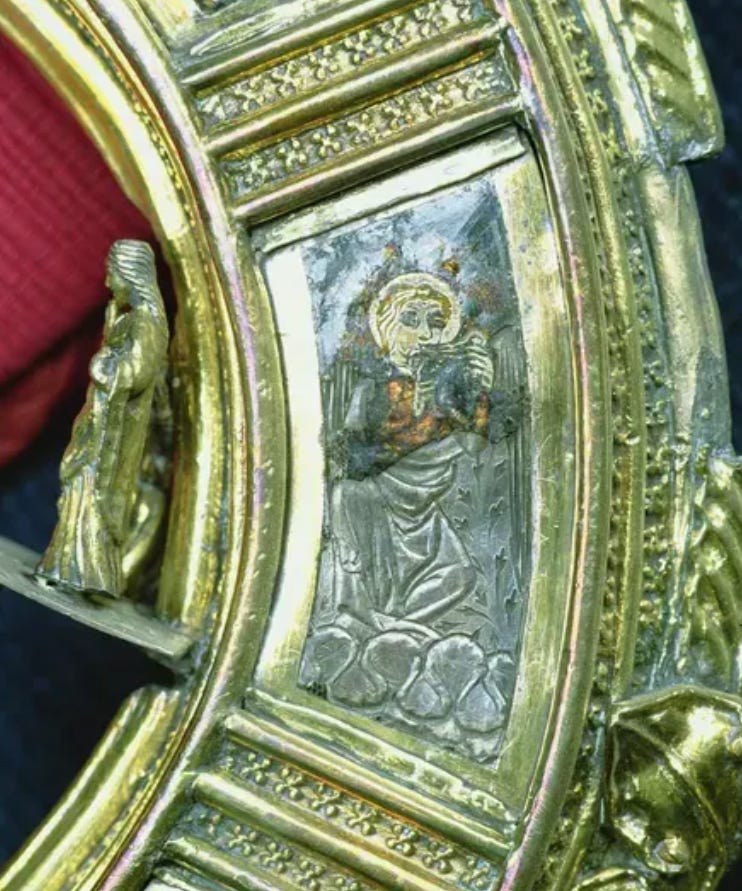
The earliest known image of the instrument is an enamel painting of an angel playing a jaw harp on the crozier (hooked staff) of William of Wykeham, Bishop of Winchester, which is dated to c1367.
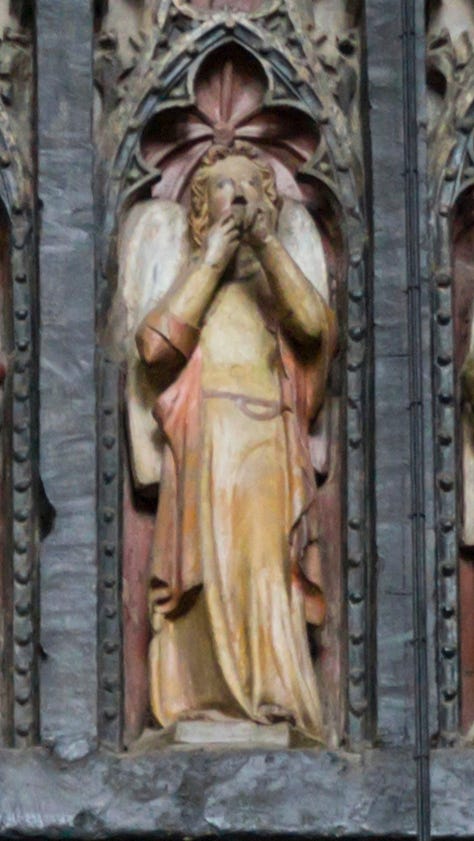
There is also a carving of an angel playing what appears to be a jaw harp at Exeter Cathedral, c. 1300s, though this is currently described (rather unconvincingly, given the position of both hands) as a ‘broken trumpet’ on the cathedral’s website.
Other late-medieval images exist from the 14th and 15th centuries, including a fresco painting of another angel playing it in the crypt of Bayeux Cathedral in Normandy, France, dated to c.1400s.
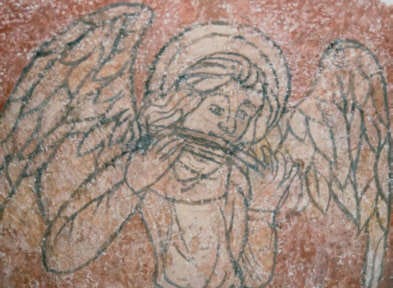
Images of angels playing a variety of ‘high’ and ‘low’ instruments were common during the period, and shows that the jaw harp was firmly embedded and recognized as a folk instrument by that time. Its appearance in church iconography during this period makes it reasonable to assume that the association with Jews came later.
The instrument was also highly associated with medieval pedlars: from 1450-1698, Frederick Crane found 13 images of pedlars with jaw harps among their wares (see Crane 2003, 9). With the Edict of Expulsion in 1290, high levels of anti-Semitism in English society at the time, and zero record of Jews actually playing it, there is a possibility that the association could have arisen though association with Jewish sellers rather than players. Again, the first time the name appears is on a trade document for a shipment from Arnemuiden (a quay of Antwerp, which was then part of The Netherlands), to London, so the instruments could well have been exported by Jewish merchants on the continent into England during the period of expulsion.
Of course we can’t ignore the possibility of a derogatory name associated with Jews and negative dismissals of the instrument as being “simple” or “inexpensive”, and indeed in later centuries these connections were sometimes drawn in satirical illustrations. However, anti-Semitic depictions seem to appear later in the 19th and 20th centuries as a result of the name, not the other way around.
The exoticization of the ‘Other’
One of the inevitable offshoots of globalization and cross-cultural trade and commerce is the formation of others, subalterns, borderlands and border people — a sense of who is an insider and who is not. The term jew’s harp carries with it a sense of a border or boundary being transgressed, an instrument or cultural object coming in from elsewhere, a sense of orientalism or exoticism. The term’s racist connotations often overshadow a larger conversation about who and what belongs, and who and what doesn’t, especially in the context of Medieval Europe. The development of a European economy during this time through increased trade meant a lot of transgression of borders hitherto not crossed, and the availability of more ‘exotic’ and foreign goods. Europeans began developing an interest in commodities that were rare or unavailable in their region.
Phons Bakx’s collection of all known names for the instrument points to several other names circulating in Europe at the time that linked the instrument with various outsider groups, particularly Romani people (Italy: trompa de zingari) and regions near borders (France: trompe de Bearne), but also, in Spain, “trompa de Paris” linking it with a major urban centre. In this context, the term ‘jew’s harp’ fits within a wider trend and is not a singular occurrence of a racialized or exoticised name. Another name that stands out is "Bojonero" (Spanish-Italian vocabulary from 1638): a peddler who sells a variety of things like needles, knives, combs, and jew’s harps, and they were usually French (in other words, outsiders).1
This group of names supports the theory that the jew’s harp could have been named for the people selling it, not necessarily those playing it. This group of names could be part xenophobia, part marketing, and it is worth considering how highlighting the instrument’s ‘otherness’ may have enhanced its perceived commercial value in earlier times as an exotic object from far away people or lands. The instrument’s marginality and outsider status, even during its peak eras of popularity, meant is has never sustained a position as a prominent mainstream object. Its association with the liminal and the fringes continues through its use in folk music, metal, and shamanic/new age spiritual music today.
Jaw harp appears several centuries after jew’s harp
Contrary to numerous online theories that jew’s harp is a ‘corruption’ of jaw harp, Wright identifies that the term jaw harp only appears around the 19th Century, after the term jew’s harp had already been in use for several centuries (2020, 37). Many other theories abound, including that jew’s harp is a corruption of jeu as in plaything (Wright 2020, 12) or jeught meaning youth or adolescent (Wright 2020, 41). Other English-language names include ‘juice harp’ and ‘gewgaw’ (both cited as possible corruptions of, or origins for, the term jew’s harp), ‘mouth harp’ (though this is often also used for harmonica), trump or tromp; regional names exist in many other languages and dialects.
Jaw harp has overtaken jew’s harp in popularity since 2018
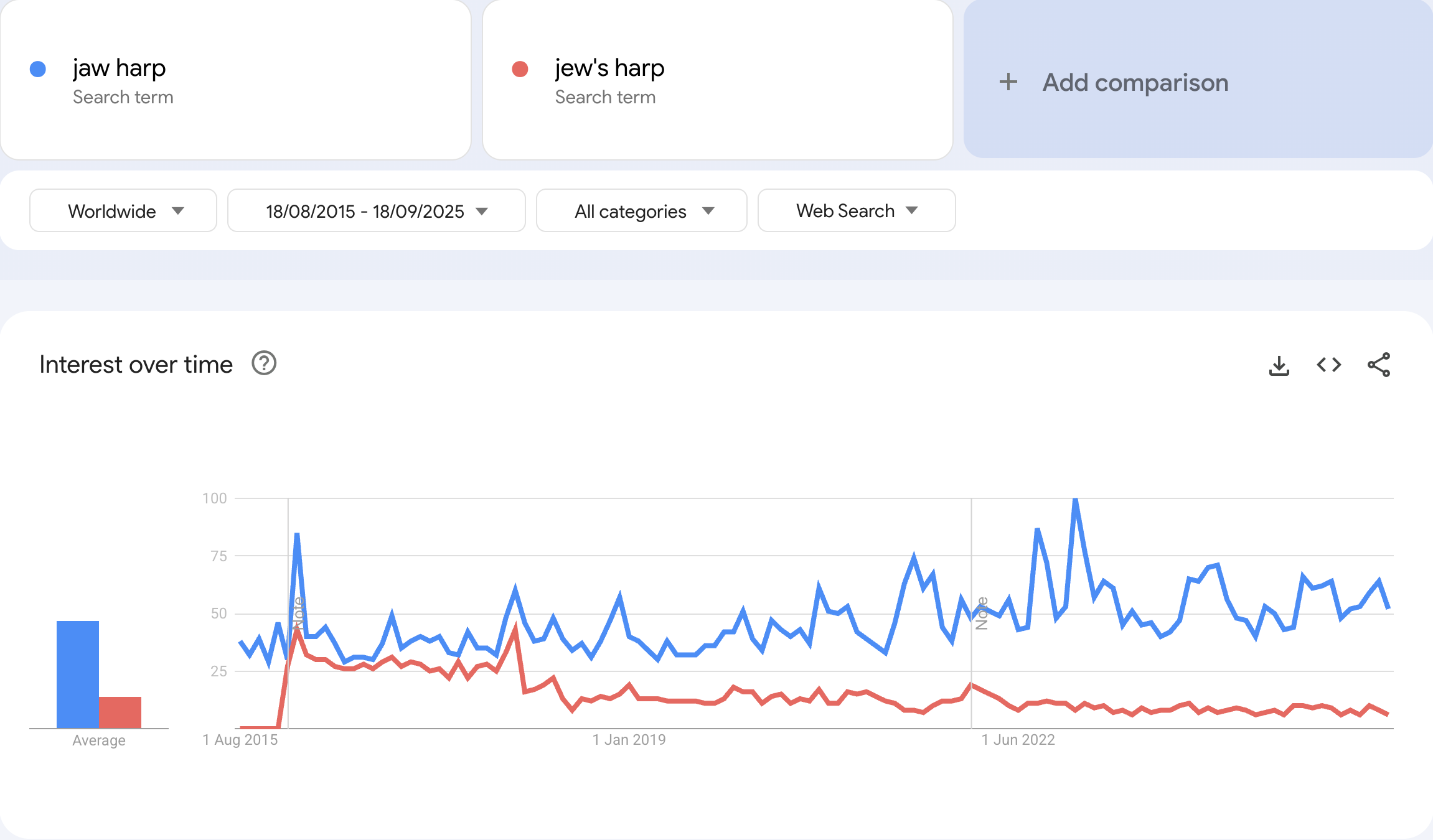
https://trends.google.com/trends/explore?date=2015-08-18%202025-09-18&q=jaw%20harp,jew%27s%20harp&hl=en-GB
While jew’s harp is undoubtedly the older term, there has been a clear shift away from it in recent years. Google Trends data, which compiles Google search data going back to 2015, shows a turning point around 2018. At this point, Google searches for the term ‘jew’s harp’ rapidly dropped off and began a steady decline, while the term ‘jaw harp’ started a gradual increase in popularity. I hypothesize that these changes could be the result of several viral videos that have garnered millions of views since 2018. After Yakut khomus player Olena Uutai’s massively viral 2018 appearance on Britain’s Got Talent, the term ‘jaw harp’ became the most commonly-searched for name for the instrument, overtaking ‘jew’s harp’ and ‘mouth harp’ by a large margin. The gap between ‘jaw harp’ and jew’s harp’ has been steadily widening since, with ‘jaw harp’ gaining increasing traction through additional viral videos, particularly YouTube videos by the Bebbcorp Harpery channel, several of which have also reached millions of viewers since 2018.
Ultimately, ‘jaw harp’ is now the most used and searched for term, not just among English speakers, but globally. ‘Jew’s harp’ is undoubtedly in decline, and it’s highly likely that given enough time, ‘jaw harp’ will eventually replace it as the primary English term. We are in the midst of that process now. That doesn’t mean the older name is inherently bad or should be thrown out; rather, it provides an opportunity to dig deeper into the history of trade, borders, and globalization in Medieval Europe.
Choose your own adventure, but know the history
What to call the instrument comes down to personal preference; many individuals are switching to jaw harp, while several organizations are still using jew’s harp (though the name issue regularly comes up for discussion).
Here’s another way of thinking about it: the jew’s harp/jaw harp has always crossed borders, and it continues to do so now. It’s a truly cosmopolitan instrument, that contains and represents knowledge and technology from many cultures over many time periods and vast stretches of geography. Its otherworldliness prompts most listeners, upon hearing it for the first time, to ask ‘where does it come from?’ There’s always a sense either that it comes from elsewhere, or that it transports us to somewhere else. I believe that jew’s harp, along with the other names in the ‘harp of the other’ cluster, contain some of these ideas and can shed light on the centuries-long process of the instrument’s globalization, particularly in Europe, where it did likely arrive via the Eastern trade routes.
So the next time you see someone online yelling ‘jew’s harp is a corruption of jaw harp!’, please send them this article!
And do let me know—what do YOU call it?
Works Cited
Bakx, Phons. ‘The 1000 Names of the Jew’s Harp.’ http://www.antropodium.nl/Duizend%20Namen%20Mhp%20voorw%20ENG.htm
Crane, Frederick. 2003. A History of the Trump in Pictures. https://jewsharpsociety.org/ijhs-publications
Kolltveit, Gjermund. 2006. Jew’s Harps in European Archaeology. Oxford: Archaeopress.
Wright, Michael, 2005. ‘Penning the air: Looking for the origins of ‘Jew’s harp’.’ The Jews Harper. https://jewsharper.files.wordpress.com/2012/09/penning-the-air3.pdf
Wright, Michael, 2015. The Jews-Harp in Britain and Ireland. Farnham: Ashgate.
Many thanks to Alessandro Zolt for the stimulating conversations around this topic!
Doingeridoo. Love this article.
ohh the troomb! i call it a twanger